Kentucky Safe Boating Course

< Previous Chapter | Next Chapter >
Index


CHAPTER 5: Safe Boat Operation

5.1 OPERATOR RESPONSIBILITIES

Ultimately, the boat operator is responsible for the safety and activity of all passengers. Additionally, the boat operator must respect other boaters and property. Before casting off, the operator should:

Pre-Departure Checklsit
  • Complete a pre-departure checklist to avoid emergencies later
  • Ensure the vessel is cared for, is in good working order, and is seaworthy
  • Ensure all passengers are properly seated and comfortable with the safety equipment and procedures in case of emergency
  • File a float plan, particularly for lengthy trips or those in unfamiliar waters
  • Check local hazards
  • Check local weather forecast and conditions
  • Life jackets are on
 

5.1.1 AGE RESTRICTIONS (KRS 235.285)

A person must be 12 years or older to operate a motorboat (including personal watercraft) 10 horsepower or over on Kentucky public waters.

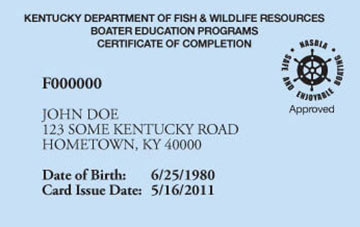
A person 12-17 years old shall possess a Kentucky Safe Boating Certificate Card or a certificate showing successful completion of a NASBLA approved boater education course or be accompanied by someone 18 years of age or older or another boater who possesses a boater education card themselves.

5.1.2 IDLE SPEED (301 KAR 6:030-3)

Kentucky law defines 'idle speed' as the "slowest speed possible to maintain maneuverability" of a boat. Generally speaking for a properly adjusted boat, this is the speed when a boat is put into gear without advancing the throttle. Wake can capsize small boats or cause damage to boats moored at marinas or docks. It is extremely important that boat operators be aware of their speed and resulting wake. Operators are liable for any injuries or damage caused by their boat's wake. Boaters may see buoys or signs that say "No Wake". This means that boats must be at 'idle speed'.


5.1.3 COURTESY

Other boaters and property owners wish to enjoy the water as well. As a courtesy to other boaters, swimmers and property owners, be sure to monitor your wake, noise level and boat speed around other boats and shoreline properties. You are responsible for any damage caused by your wake. Be sure to take the time to review proper safety and operation procedures if you let someone else operate your boat. Be particularly mindful of your boat noise in the early morning and late evening. Leave the water as you found it: clean up any waste you encounter and be sure to collect any of your own waste in a garbage bag and dispose of it properly once you get to shore.

5.1.4 RECKLESS OPERATION (KRS 235.285)

The operator of a watercraft is responsible for damage caused by negligent operation. The following actions are considered reckless operation and are therefore against the law:

  • Weaving through traffic;
  • Failing to keep an adequate distance from a craft that is involved in towing activities, surfboards or other water sport devices.
  • Jumping the wake of a vessel in any unsafe manner, endangering any person or property;
  • Cutting between a boat and the individual(s) being towed by the boat;
  • Crossing the path of another vessel during periods of reduced or obstructed visibility;
  • Steering toward an object or individual in the water and turning sharply at close range.
  • Persons shall not operate a motorboat or personal watercraft within 50 feet of a commercial vessel and its tow that is in operation on a waterway, except if the operator of the commercial vessel has given consent.
  • When operating in a busy area, reduce speed and allow plenty of room for avoidance maneuvers. Even in areas that are not marked as 'idle speed', excessive wake can still be dangerous. Operators of larger craft should be aware of the wake their vessels are throwing.

5.1.5 Prohibited Riding (301 KAR 6:030-5)

In Kentucky, when operating a motorboat above idle speed the operator or passengers shall not ride on an enclosed bow, on a houseboat or a pontoon outside the protective railings, on a seat which extends six inches above the plane of the gunwales, nor shall they ride on the sides, back, engine cover, back of the seats, or in any other obviously dangerous position where there is a danger of falling overboard.


5.1.6 NEGLIGENCE

Any type of boating vessel demands an operator's respect and attention. Careless or reckless behavior aboard any vessel can result in dangerous consequences. A boat is not a toy. Enjoy your boating experience, but be mindful of the power of many vessels and the inherent dangers that water presents.

5.1.7 MUFFLERS AND NOISE LEVELS (KRS 235.200)

Kentucky law defines 'idle speed' as the "slowest speed possible to maintain maneuverability" of a boat. Generally speaking for a properly adjusted boat, this is the speed when a boat is put into gear without advancing the throttle. Wake can capsize small boats or cause damage to boats moored at marinas or docks. It is extremely important that boat operators be aware of their speed and resulting wake. Operators are liable for any injuries or damage caused by their boat's wake. Boaters may see buoys or signs that say "No Wake". This means that boats must be at 'idle speed'.


5.1.8 HOMELAND SECURITY MEASURES

Federal, state and local governments have enacted specific measures since the events of September 11, 2001, to help deter unlawful or dangerous operations on our nation's waterways. Homeland Security Measures violations can result in severe consequences. Please be aware of the following Homeland Security Measures, and act accordingly to keep our waterways safe and secure:

Keep your distance from military vessels
  • Do not approach closer than 100 yards from all military, cruise-line, or commercial shipping vessels.
  • Slow to "no wake" speed within 500 yards of any large U.S. Navy vessel
  • Observe and avoid all security zones.
  • Avoid areas with military, cruise-line, or petroleum facilities.

FOR INFORMATION in port areas, you can call 1-800-682-1796, visit http://www.uscg.mil/safeports/, or check with local authorities.

  • Observe other restricted areas near dams, power plants, etc.
  • Do not stop or anchor beneath bridges or in channels.
  • Report any suspicious activity immediately to local authorities, the U.S. Coast Guard, or marine security personnel, or call the National Response Center's Terrorist Hotline at 1-800-424-8802.
  • In Kentucky you may also report suspicious activity to 1-866-EYE-ON-KY (1-866-393-6659)
  • Do not approach or challenge those acting in a suspicious manner, and never confront the suspicious party.
  • Ensure your boat is always locked and secured when unattended, and always take the boat keys with you.

5.2 INFLUENCE OF DRUGS AND ALCOHOL ON BOAT OPERATION

5.2.1 DRIVE SOBER

Because of the fatiguing effects of the sun, wind and the motion of the boat, one drink on board is like three on shore! This means if you are drinking at all, then you should not be operating a boat or PWC. Do not jeopardize your safety or the safety of other boaters or the passengers in your care. Your balance, vision, coordination and judgment are all affected adversely by the consumption of even one alcoholic drink. Coupled with environmental elements (sun, glare, wind, motion), alcohol can have very serious consequences on the water. Please be responsible when operating your boat. If you are operating a vessel, you should avoid alcohol consumption.

 
MYTHS REALITY
"A few beers won't hurt." Even in small amounts, alcohol affects coordination and judgment. A bottle of beer, a glass of wine, or a drink of liquor all produce the same effect.
"Most drowning accidents result from swimming." More than 60% of drowning accidents occur after the victim accidentally falls off a dock, shoreline or vessel into the water. Autopsies show that more than one-third of the victims of such falls (mostly men) were impaired by alcohol at the time of the accident.
"Drinking alcohol while operating a boat is not a serious offence." Operating a boat while intoxicated is just as dangerous as operating a car in that condition. The marine authorities are equipped with Breathalyzers. If the results are positive, the police may lay charges.
"There's no harm in drinking alcohol on the beach before swimming." Alcohol affects judgment. The person drinking can easily overestimate their abilities or misjudge a risk they would not take under normal circumstances. Furthermore, it is illegal to drink in some public places, such as a beach or a dock.
Source: "Water and alcohol—myths and realities." Red Cross Society"

5.2.2 SERIOUS PENALTIES (KRS 235.240)

It is against the law to operate a boat or vessel including personal watercraft, manipulate water skis, a surfboard or other similar device while intoxicated or under the influence of any other substance that impairs one's driving ability. Any person who operates a vessel on Kentucky waters is considered to have given consent to a test or tests to determine his alcohol concentration or the presence of other drugs. The tests shall be administered at the direction of a law enforcement officer who has probable cause to believe that the operator is intoxicated. An operator refusing the test shall be in violation of the law and subject to the same penalties.

Anyone who operates a boat, PWC, skis, surfboard or similar device while intoxicated with a blood alcohol level of 0.08% or higher or while under the influence of any substance that impairs the operator's driving ability may be subject to fines and possible jail time if convicted.


5.3 CARBON MONOXIDE: PROTECT YOURSELF FROM THIS SILENT KILLER

Carbon monoxide can collect within, alongside or behind a boat in minutes and in a variety of ways.


5.3.1 AVOID THESE DEATH ZONES!

Do not swim near or under the back deck or swim platform. Carbon monoxide from exhaust pipes of inboard engines, outboard engines and generators build up inside and outside the boat in areas near exhaust vents. STAY AWAY from these exhaust vent areas and DO NOT swim in these areas when the motor or generator is operating.

On calm days, wait at least 15 minutes after the motor or generator has been shut off before entering these areas. NEVER enter an enclosed area under a swim platform where exhaust is vented, not even for a second. It only takes one or two breaths of the air in this "death chamber" for it to be fatal.


EXHAUST FUME DANGERS

Blocked exhaust outlet

Blockage of exhaust outlets can cause carbon monoxide to accumulate in the cabin and cockpit area—even when hatches, windows, portholes and doors are closed.

 
Exhaust from another vessel

Exhaust from another vessel that is docked, beached, or anchored alongside your boat can emit poisonous carbon monoxide gas into the cabin and cockpit of your boat. Even with properly vented exhaust, your boat should be a minimum of 20 feet from the nearest boat that is running a generatoror engine.

 
Los speed or idling

Slow speeds or idling in the water can cause carbon monoxide gas to accumulate in the cabin, cockpit, bridge, and aft deck, even in an open area. A tailwind (force of wind entering from aft section of the motorboat) can also increase accumulation.

 
Station wagon effect

The "station wagon effect," or backdrafting, can cause carbon monoxide to accumulate inside the cabin, cockpit and bridge when the boat is operating at a high bow angle, with improper or heavy loading, or if there is an opening that draws in exhaust. This effect can also cause carbon monoxide to accumulate inside the cabin, cockpit, aft deck, and bridge when protective coverings are used and the boat is underway.

 
NO teak surfing!

Teak surfing, dragging and water skiing within 20 feet of a moving watercraft can be fatal.


5.3.2 WHAT TO DO

  • The best precaution against carbon monoxide poisoning is to keep air flowing through the vessel.
  • Educate your passengers about carbon monoxide so they are aware of what the early poisoning signs are.
  • If your boat has a rear-vented generator exhaust, check with the boat manufacturer for possible recall, or reroute the exhaust to a safe area.
  • Assign an adult to watch when anyone is in the water.
  • Schedule regular engine and exhaust system maintenance inspections by experienced and trained technicians.
  • Keep forward-facing hatches open, even in inclement weather, to allow fresh air circulation in living spaces. When possible, run the boat so that prevailing winds will help dissipate the exhaust.
  • Do not confuse carbon monoxide poisoning with seasickness, intoxication or heat stress.
  • If someone aboard complains of irritated eyes, headache, nausea, weakness or dizziness, immediately move the person to fresh air, investigate the cause, and take corrective action. Seek medical attention, if necessary.
  • Install a carbon monoxide detector in each accommodation space on your boat. Check detectors before each trip to be sure they are functioning properly. If the detector goes off, believe it!
 

5.3.3 FACTS ABOUT CARBON MONOXIDE

Carbon monoxide is a potentially deadly gas produced any time a carbon-based fuel, such as gasoline, propane, charcoal or oil, burns. Sources on your boat include gasoline engines, generators, cooking ranges, and space and water heaters. Cold or poorly tuned engines produce more carbon monoxide than warm, properly tuned engines.

Carbon monoxide is colorless, odorless and tasteless, and it mixes evenly with the air. It enters your bloodstream through the lungs and displaces the oxygen your body needs. Early symptoms of carbon monoxide poisoning— irritated eyes, headache, nausea, weakness and dizziness—are often confused with seasickness or intoxication. Prolonged exposure to low concentrations or very short exposure to high concentrations can lead to death.

Each year, boaters are injured or killed by carbon monoxide. Most incidents occur on older boats and within the cabin or other enclosed areas. Exhaust leaks, the leading cause of death by carbon monoxide, can allow carbon monoxide to migrate throughout the boat and into enclosed areas. New areas of concern are the rear deck near the swim platform with the generator or engines running, and teak surfing or dragging behind a slow-moving boat. Regular maintenance and proper boat operation can reduce the risk of injury from carbon monoxide.

5.3.4 PREVENTION CHECKLISTS

ALL CARBON MONOXIDE POISONINGS ARE PREVENTABLE!

CHECKLIST: EACH TRIP

  • Educate all passengers about carbon monoxide poisoning.
  • Make sure all exhaust clamps are in place and secure.
  • Look for exhaust leaking from exhaust system components, indicated by rust and/or black streaking, water leaks, or corroded or cracked fittings.
  • Inspect rubber exhaust hoses for burned or cracked sections. All rubber hoses should be pliable and free of kinks.
  • Confirm that water flows from the exhaust outlet when the engine and generator are started.
  • Listen for any change in exhaust sound that could indicate an exhaust component failure.
  • Test the operation of each carbon monoxide detector by pressing the test button. Make sure the battery is installed properly and is in good condition. Never remove the battery unless you are replacing it with a new battery.
  • Move seated passengers around the boat periodically to prevent any one from continuously being near any fumes.

CHECKLIST: AT LEAST ANNUALLY

  • Replace exhaust hoses if you see any evidence of cracking, charring or deterioration.
  • Inspect each water pump impeller and the water pump housing, and replace them if they are worn. Make sure cooling systems are in proper working condition to prevent overheating and possible burning of the exhaust system. (Refer to the engine and generator manuals for further information.)
  • Inspect each of the metallic exhaust components for cracking, rusting, leaking or loosening. Pay particular attention to the cylinder head, exhaust manifold, water injection elbow, and threaded adapter nipple between the manifold and the elbow.
  • Clean, inspect and confirm proper operation of the generator cooling water anti-siphon valve (if equipped).

THE ANNUAL CHECKLIST TEST MUST BE PERFORMED BY A QUALIFIED MARINE TECHNICIAN.

5.4 PROPELLER INTERVENTION AND AWARENESS

Rotating at great speeds and with a lot of power, the potential danger posed by boat engine propellers should not be overlooked. Each year hundreds of Americans accidentally come into contact with moving propeller blades. In 2006 alone, the US Coast Guard reported, 234 people struck by propellers with 28 fatalities.

Since the propeller is located below the waterline and may be difficult to see, it is important that people are at all times aware of the propeller. This is most important when in the water near the rear of a vessel or on the swim platform. As a precaution, operators should shut off the engine whenever a person is in the water within close proximity to their vessel.


Safety equipment is available and when used properly can significantly decrease the probability of a propeller strike. Common examples of equipment are:

  • Propeller guards
  • Ladder interlock kill switches
  • Man over board cut-off switches
  • Lanyard engine kill/stop switches
 

CHAPTER 5 SUMMARY

AFTER READING CHAPTER 5, YOU SHOULD HAVE KNOWLEDGE OF:

  • Operator responsibilities, and safe and unsafe practices on the water
  • The influences of drugs and alcohol on boat operation
  • The enforcement of the federal and state laws regarding boating

Kentucky Safe Boating Course

< Previous Chapter | Next Chapter >
Index


USCG NASBLA
All course material contained herein is approved by the National Association of State Boating Law Administrators and recognized by the U.S. Coast Guard Office of Boating Safety.