Tennessee Safe Boating Course

Next Chapter >
Index
 

Chapter 1: The Boat

1.1 Boat Terminology

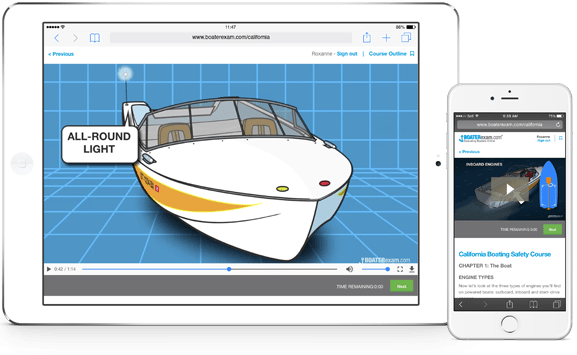
There are specific boating terms used to describe the various parts of a boat. Each end and side of the boat, the length and width, and boat accessories have specific terms. Every boater should be familiar with the following terms before operating a boat:

Powerboat
Bow:
front part of vessel
Port:
left side of vessel
Powerboat Starboard:
right side of vessel
Stern:
back of vessel

1.2 Boat Lengths

Powerboat lengthBoats are identified in classes by length. Federal and state laws require certain equipment aboard boats depending on the class or length of the boat.

  • Class A: less than 16 ft
  • Class 1: 16 ft to less than 26 ft
  • Class 2: 26 ft to less than 40 ft
  • Class 3: 40 ft to less than 65 ft

A boat's length is measured along its centerline from the outside of the bow to the outside of the stern. This measurement does not include any attachments such as swim platforms, wakeboard towers

1.3 Boat Hull Designs and Uses

Boat bottoms or 'hulls' come in a variety of shapes and sizes. Each unique hull type is designed to either displace or plane through the water. Sailboats and large cruise ships use displacement hulls because they allow larger boats to move through the water smoothly. On the other hand, smaller powerboats are typically built with planing hulls that are designed to rise up and ride on top of the water at higher speeds than displacement hull boats.

1.3.1 Hull Types

Flat bottom hull Flat bottom - These boats are generally designed for slow speeds and calm water. Flat bottom boats tend to be less stable than other hull types in rough water.
Round bottom hull Round bottom - Round bottom boats, like canoes, move smoothly through the water with little effort. Boaters must be cautious when loading, entering and exiting a round bottom boat - due to the hull design, these boats roll very easily.
Deep-V Hull Deep-V hull - The deep V-hull is the most common hull type for powerboats. These boats move through rough water, at higher speeds and a smoother ride than flat bottom or round bottom boats. These boats require larger engines than flat bottom or round bottom boats.
Multi Hull Multi-hull - Multi-hull boats are the most stable of the hull types. These boats require plenty of room to steer and turn. Catamarans and pontoon boats use the multi-hull design.

1.3.2 Engine Types

Outboard Engine

Outboard - Outboard engines are typically two-stroke engines. Two-stroke engines require oil to be mixed with the fuel to lubricate the engine. An outboard is mounted on the transom of the boat. Steering of outboards is controlled by a hand tiller or a steering wheel which moves the entire engine when steering is adjusted.

Inboard engine

Inboard - Inboard engines are typically four-stroke automotive engines that are modified for use on the water. An inboard engine is mounted inside the hull of the boat and powers the drive shaft which is connected to a propeller. Steering is controlled by a rudder, positioned directly behind the propeller.

Stern Drive

Stern Drives - Stern drives are often called inboard/outboards (I/O) because they have features found on both inboard and outboard engines. Similar to inboards, stern drives use four-stroke automotive engines that are modified for use on the water. Stern drive engines are mounted inside the boat and attached through the transom and powers the drive shaft which is connected to a propeller. Similar to outboards, the entire engine moves when the steering wheel in a stern drive is adjusted. 

1.4 Boat Capacities

Be aware of the Small Vessel Regulations pertaining to engine power and load capacity.

Federal Law mandates that boats of less than 20 feet in length must have a Capacity Plate in the steering or helm area. As a boat owner or operator you should know that the "recommended gross load capacity" that can be safely carried in the hull:

  1. Includes the total weight of persons, equipment, stores, fuel, motor assembly and steering controls;
  2. Is indicated with the "equivalent number of adult persons"; and
  3. Is indicated on a Capacity Plate which, if fitted, is permanently attached to the pleasure craft.

The capacity plate also indicates the "recommended safe limits of engine power" for the hull concerned. This calculation is based on the recommended gross load capacity.

Capacity Plate

1.4.1 Overloading or Over-Powering

Warning Beware of Bad Weather

Take much lighter loads in poor weather conditions to ensure boat stability.

Bad Weather

An overloaded boat or over-powered boat can be extremely dangerous. An over-powered boat may cause the stern to sit lower in the water, making the vessel susceptible to being swamped by its own wake or that of a passing boat. Similarly, too much weight in the stern or the bow will make the vessel prone to swamping. Additionally, it is important to spread the load evenly throughout the vessel. Too much weight on either side will make the vessel less stable and more apt to capsize. Take extreme caution in loading your vessel properly.

1.4.2 Safe Loading Guidelines (for small boats)

To determine the Horsepower Capacity for small, flat-bottomed boats, multiply the boat length (ft) by the transom width (ft) and compare the resulting value to the following chart:

Example

Boat Length = 12 ft
Boat Width = 4 feet

12ft x 4ft = 48

Max HP of 15

Length x Width Max. HP
35 or less 3
36-39 5
40-42 7.5
43-45 10
46-52 15

1.4.3 Person Capacity:

Manufacturers take a number of variables into account when determining the maximum person capacity for a boat (which is displayed on the capacity plate). The maximum person capacity is a guideline. Keep in mind that most manufacturers assume an average weight per person of 150 lbs. If you have passengers over or under 150 lbs - you should adjust the maximum person capacity accordingly.
Properly Loaded Boat Overloaded Boat

Hull Identification Number

1.5 Hull Identification Number (HIN)

All new pleasure crafts manufactured since 1972 are permanently marked with a Hull Identification Number (HIN), which is the 12 character serial number of your vessel. To identify and register your vessel properly, HINs are marked at the stern on the starboard (right) side, or as close to that area as possible.  You must NOT deface or alter the HIN. The HIN indicates:

  • the boat manufacturer
  • its serial number
  • the month and year of production

1.6 Boat Registration Requirements

1.6.1 Boat Registration and Numbering

All motorized boats, regardless of state, must be registered. Some other boats must be registered as well.

Federally Documented Vessels: Large recreational boats can be federally registered with the U.S. Coast Guard. Federally Documented Vessels must also be registered in Tennessee but are not required to display the numbers.

1.6.2 Tennessee Registration Requirements

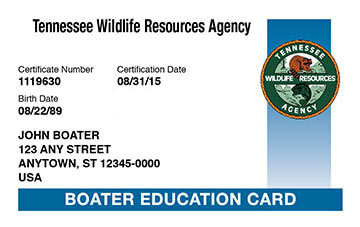
Tennessee Wildlife and Resource Agency (TWRA):
The TWRA is responsible for regulating the state boating laws in Tennessee.

1.6.2.1 Registration/Titling

All boats propelled by machinery, including gasoline, diesel and electric motors, and principally operated on Tennessee waters must be registered with the Tennessee Wildlife and Resource Agency (TWRA). Exceptions for boat registration include:

  • Non-motorized vessels such as canoes or kayaks
  • Vessels that are properly registered in another state and that are operating on Tennessee waters for less than 60 consecutive days

An application for boat registration is available from the boat dealer or through a county clerk's office, and must be sent to the Tennessee Wildlife Resources Agency.

Note

On the reverse of the Certificate of Ownership there is an application for the transfer of ownership.

1.6.2.2 Certificate of Ownership

Boat owners must keep their Certificate of Ownership in a safe place.

1.6.2.3 Certificate of Number

Boat owners must have at least a temporary Certificate of Number before they can operate in state waters. Upon receipt, the permanent Certificate of Number must be signed and carried onboard when the operating.

The Certificate of Number is set to expire (and must be renewed) after one, two, or three years at the owner's preference. The vessel owner is required to inform the TWRA within 15 days of the following events:

  • He or she changes address.
  • The vessel is sold, abandoned, destroyed, lost or stolen and/or recovered

Vessels do not require registration in Tennessee as long as they are properly registered in another state and are operating in Tennessee for no more than 60 consecutive days.

If the Certificate of number or decals are lost or destroyed, the boat owner must apply for a duplicate, at a processing fee.

1.6.2.4 Registration fees

Size Years
1 2 3
16 feet and under $10 $19 $28
Over 16 feet to less than 26 feet $20 $38 $56
26 feet to less than 40 feet $30 $57 $84
40 feet or more $40 $76 $112
Dealer/Manufacturer $25 $50 $75
Duplicate certificate $5

Successful registration results in a certificate of number, physical boat numbers and a decal. Your registration MUST be kept on board the vessel at all times. (It is advisable to keep the registration in a dry-bag on board.) Boat numbers must:

  • be affixed on both sides of the bow
  • be block letters, three inches high and contrasting with the color of your boat
  • Letters must be separated from the numbers by a space:
Tennessee Powerboat Registration

For example: TN-123-BX or TN 123 BX. This is a federal and state requirement.

Lack of the correct documentation can result in delays and fines.

Make sure all boats are properly marked and documented. It's important to keep your papers with the boat - be particularly aware when transferring ownership of your vessel.

Chapter Summary

Upon completion of reading Chapter 1 material, you should have knowledge of:

  • Specific terms that are used to name/describe the parts of a boat
  • Various boat classes that are identifiable by length
  • Types of boat hulls and their characteristics
  • Engines
  • Boat capacities
  • What a Hull Identification Number is and what it should indicate
  • State boat registration regulations, requirements and allowances

Tennessee Safe Boating Course

Next Chapter >
Index


USCG NASBLA
All course material contained herein is approved by the National Association of State Boating Law Administrators and recognized by the U.S. Coast Guard Office of Boating Safety.