How to Read a HIN Number
A Hull Identification Number (HIN) can tell you a lot about your boat—but first you must learn how to find, read, and decode the HIN's 12-character message. By doing this, you will discover the exact brand, model, date of manufacture, and model year of your boat.
In short:
- Start by breaking it down into its different components. The first three characters in the HIN reveal the manufacturer's name, such as CCB for Chris-Craft Boats or BWC for Boston Whaler Inc.
- The next five characters in the HIN are the serial number for your specific vessel and may include letters or numbers.
- The ninth character refers to the year of manufacture, and the final two identify the boat's model year.
Let's look at what the HIN is and how it can help you learn more about your boat.
What is a HIN Number?
The Hull Identification Number is a unique identifier assigned to every recreational boat. HINs have been a requirement for boats manufactured or imported since 1972. Although the U.S. Coast Guard has made some changes to the format, the current format has been the standard for vessels built and sold since 1984.
If you've seen your car's VIN, you may have wondered: Do boats have VIN numbers? Essentially, yes!
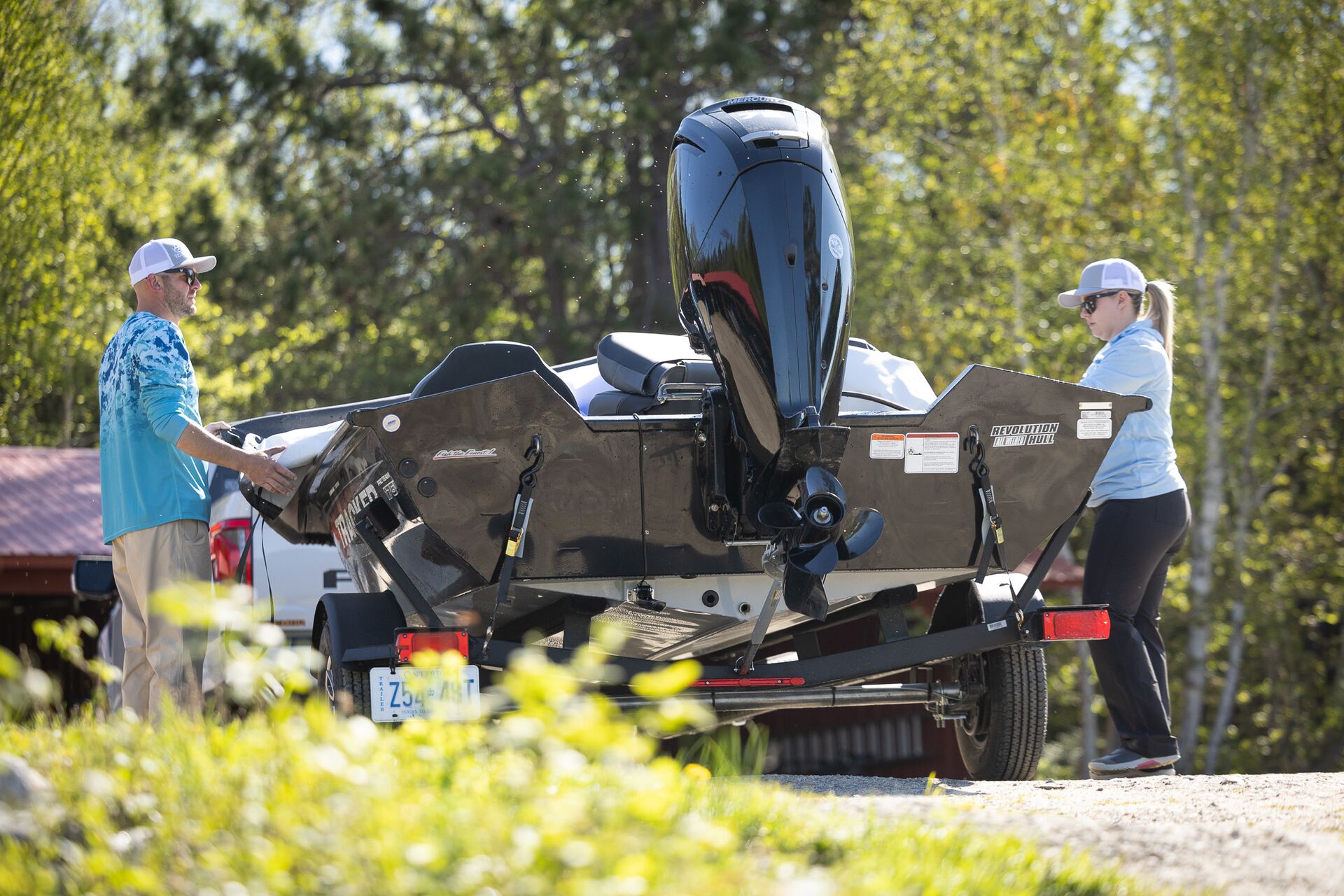
The Hull Identification Number serves a similar purpose as a VIN by registering, tracking, and identifying a specific boat. You'll typically find the boat's HIN on the starboard side of the transom, near the top edge.
The HIN number boat details will tell you precisely what you're buying, selling, or sailing. You can access recall reports or warranty notices, and even review accident records.
What Does a HIN Number Reveal?
So what is a HIN? It's more than a random serial number; it's a message containing valuable data. You can learn who built the boat, its manufacture date, and its model year.
HIN data provides a basic description of the vessel and allows you to conduct further research. For example, a number such as BUJ53005A989 indicates that White River Marine Group built this Pro 17 model in January 1989 and sold it as a 1989 model year. From there, we can review a list of recalls and compliance issues for the boat (according to the U.S. Coast Guard, there are no recall bulletins for the 1989 Pro 17 model!).
Other manufacturers provide hidden details in their HINs. With Sea Ray HINs, the Manufacturer Identification Code is SER, and the fourth letter tells you the name of the city where the boat was built, with T for Knoxville, Tennessee; F for Merritt Island, Florida; and P for Palm Coast, Florida.
When you decode "SERP3750D797," you learn that the boat is a Sea Ray Model 400DB, manufactured in April 1997, and built in Palm Coast, Florida.


Why is a HIN Important for Boats?
Knowing the HIN is important because it allows you to confirm the boat's precise identity for registration and titling. As part of this process, some states may require an inspection to verify the HIN. You will also use the HIN to monitor and track notices published about your specific boat, such as recalls, warranty information, and manufacturer announcements.
In fact, most boating transactions require HINs on the paperwork to document a boat's ownership. The HIN is an essential piece of information for preventing theft and recovering a lost or stolen boat. You can use the HIN for insurance purposes and for resale verification should you decide to sell the boat.
The HIN also helps you become a more active, informed part of the boating community. If you want to know more about the fuel system on your Cobia center console and you post a generic description of your boat online, you'll likely receive vague answers. When you can say with certainty that you have the Model 237 built in April 2017, you'll get better responses.
What is the Format of a HIN Number?
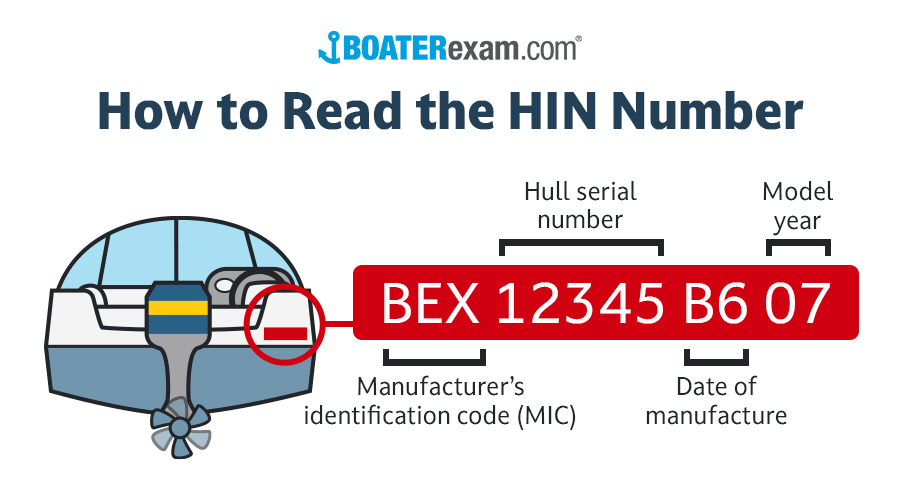
The HIN format comprises 12 alphanumeric characters, with the following structure:
Manufacturer code (three characters) + serial number (five) + month (one) + year built (one) + model year of the vessel (two)
When the month is given, the HIN uses the letters A–L, where A is for January, B is for February, and so on, with L representing December.

How Do I Decode a HIN Number Boat ID?
You can figure out what is a HIN and decode it by breaking the 12 characters into five sections.
- The first three letters: the Manufacturer Identification Code (MIC).
- The next five characters: a unique serial number from the builder (since Q, O, and I can be mistaken for numbers, those letters are not used).
- The eighth letter in the series: the month of manufacture.
- The ninth character: the year of manufacture (a digit).
- The last two numbers: the boat's model year.
This system works for boats manufactured after 1984. However, boats from 1972–1984 use a slightly different HIN system with either a Straight Year Format including the production month (such as 11 for November and 80 for 1980) or a Model Year Format with the last three characters indicating the model year and month of certification.
Tip: You can tell the HIN is using the Model Year Format when the ninth character is an M.
How to Look up a Hull Identification Number
You've located and decoded the boat's HIN—now it's time to dive into the research.
Start with the U.S. Coast Guard's MIC database, which includes basic information and codes for manufacturers, regardless of whether they are out of business or still producing boats. You can also use the HIN to look up vessels in the Coast Guard's Port State Information Exchange.
Check with your state's boating agency for HIN number boat information, or access online registration databases. Insurance companies and marine documentation companies also track the history of vessels through the HIN.
When purchasing a used boat, it's worthwhile to run the HIN through a theft-recovery database or obtain a historical report of the vessel. These services can provide documentation about accidents and damage claims.
Make sure the paperwork matches the physical HIN on the boat's transom.

Understand Your Boat and Stay Safe with Boater Education
Boaters need to know how to read charts, maps, the seas, and a boat's hull identification number. By understanding a HIN, you can get a better view of your boat's history.
As you become a more seasoned boat operator, there is always more to discover. A boater education course helps you learn more about your boat and how to stay safe on the water. Plus, most states require boat operators to be boat safety certified with essential knowledge of safety gear, navigation, equipment requirements, maneuvering around other boats, docking procedures, and more.
BOATERexam is here to help you learn about your boat, boat safety, and meet your state's requirements or Canada's requirements for boater education!


Frequently Asked Questions (FAQs)
We have answers to your questions about how to read a HIN number!
Q: How do I decode a HIN number?
A: To decode a HIN number, break it into three parts: the manufacturer’s ID (who built it), the serial number (unique to the boat), and the date code (month/year built or model year).
Q: What does a HIN number reveal?
A: The HIN number identifies the boat’s manufacturer, confirms the hull’s unique identity, and shows when the boat was built or its model year. This is useful for registration, recalls, and theft checks.
Q: What is the format of a HIN number?
A: In the U.S., the HIN number is a 12-character code: 3 characters for the manufacturer, 5 for the serial number, and 4 for the date/model year (e.g., ABC12345M84D).
Q: How do I look up a Hull Identification Number?
A: To look up a Hull Identification Number (HIN), check the boat’s registration/title, then use your state boating agency, the U.S. Coast Guard Manufacturer Identification Code (MIC) database, or a marine history service to verify details.